
All Blog Posts
• • •
- Starting Out
1st Post. A bit about me, I work in the Inland Marine Transportation industry. My job takes me on the road a lot. Since late 2014 I have averaged a bit over 72,000 miles per year on my company assigned vehicles. I’ve been to St. Paul,MN and New Orleans, LA and Pittsburgh, PA…sometimes in the same week. Between those cities are countless small towns on our countries great rivers full of interesting, gracious human beings from all walks of life. The best part of my job is the travel. The worst part of my job is the travel. I love being on the road, but I hate being away from home and family. Almost a full decade now of this dichotomous life, but I regret very little of it. I am a one bag travel kind of man, necessitated by the need to be agile with sometimes rapidly changing travel destinations. Im still looking for the perfect travel backpack, I have a favorite for now, but it’s not perfect. I also love tech, and all aspects of the fishing world. This will not be my outlet for fishing content though. Tech, travel gear, and Inland Maritime topics will be my focus. If I review a product, I’ve used it extensively, I feel there is very little use for “unboxing” content, I want to know how it holds up. My career and the industry i am a part of is rough and tough on gear, so am I.
- Learning to Make a Video 1.0
Recently I found myself in a situation where I was asked at work to take on a monumental long term project: produce and publish an extensive library of skills based training videos for our field level employees. Cool, I said, I can do that no problem. Of course in saying that, those I’d just committed to, had no idea I had no idea how in the hell to do any of that. At all. I mean, I’ve watched plenty of YouTube, it can’t be that hard right?
Ha! I knew so little I wasn’t capable of knowing how much I didn’t know. But I was committed and determined to figure it out. I went through several iterations of freeware editing software and poor attempts at filming on my iPhone before realizing I’d need a bit better tools. So back to YouTube I went. Eventually I came upon a video showing DaVinci Resolve Studio for iPad and thought I’d give the free version a try on my 2020 iPad Air I already had. This immediately made more sense to me for whatever reason, namely the touch controls. So that part was solved temporarily, next was what to shoot on. Due to the nature of the where and what I am filming, I opted for a DJI Osmo Pocket 3, and while I know now it isn’t the most ideal solution, its a heck of an upgrade from my 1st generation iPhone SE.
Now I’m cooking with gas. Except I still don’t know how to actually film anything quality to give me a fighting chance once I get to the editing page. I knew I needed a shot list and some form of a script so I at least can make sure I get the shots I need, I wrote those up and went on location and went to work. Luckily, I have over a decade of learning, performing, and training on these skills, so the subject matter I have an in depth knowledge of, this helped immensely.
Video shoot. Check. Fully edited and published. No check. Twenty some odd hours later I took 35 minutes of raw footage and turned it into 3.5 minutes of video. I was stoked though, I’d made something.
I’ll get into the tools I use at some point, it’s unconventional and possibly insane, but it’s working for me. In six weeks time I now have 9 videos published for our field guys to now have access to. They’re not polished, fancy or professional, but they are concise, effective, and efficient.
- EDC Gear Review | Leatherman Arc Multitool | 1 Year EDC Use
Overview:
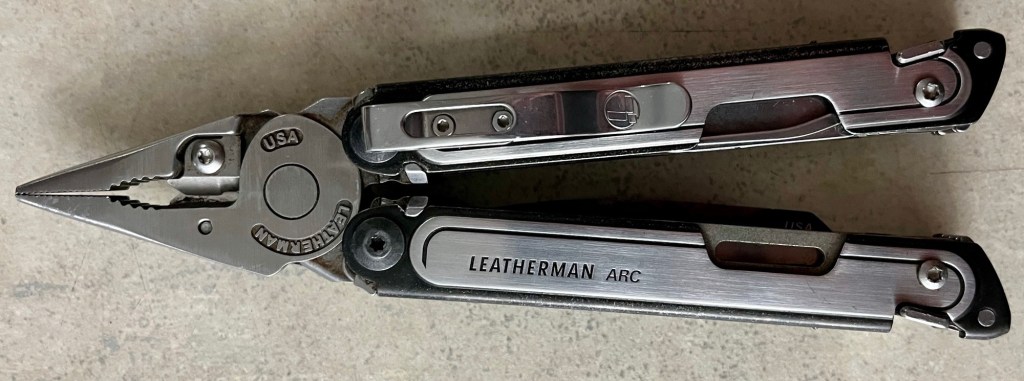
I have been carrying the Leatherman Arc since receiving it as a Christmas present at the end of 2023. Now, 10 months later, it still has a permanent spot in my right front pocket daily. In fact, aside from 5 days I was on a cruise in July, it has been in that pocket every other day since I have owned it.
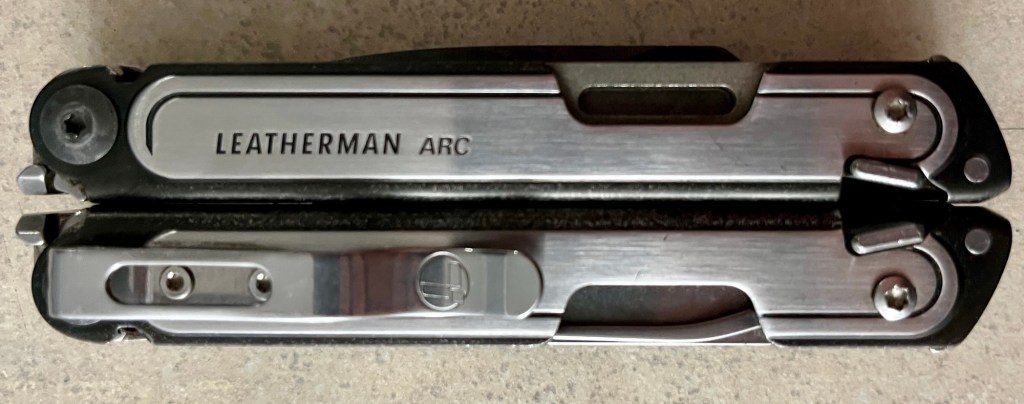
The ARC isn’t my first foray into the Leatherman or multi-tool world. Somewhere around my house and workshop are a Charge TTI, original Micra, Squirt, Surge, original Wave, and a couple of the Free knives, all from Leatherman. The fact I predicated that statement with “Somewhere around my house” should tell you a great deal how successful previous attempts to introduce a multitool into my EDC have been. Until the ARC. I’m not going to go into great detail on the individual tools and the specifics of the Arc itself, Leatherman does a fine job of that on their website. I want to cover how this fits into my daily life and what I specifically find handy with its configuration.
The Blade:
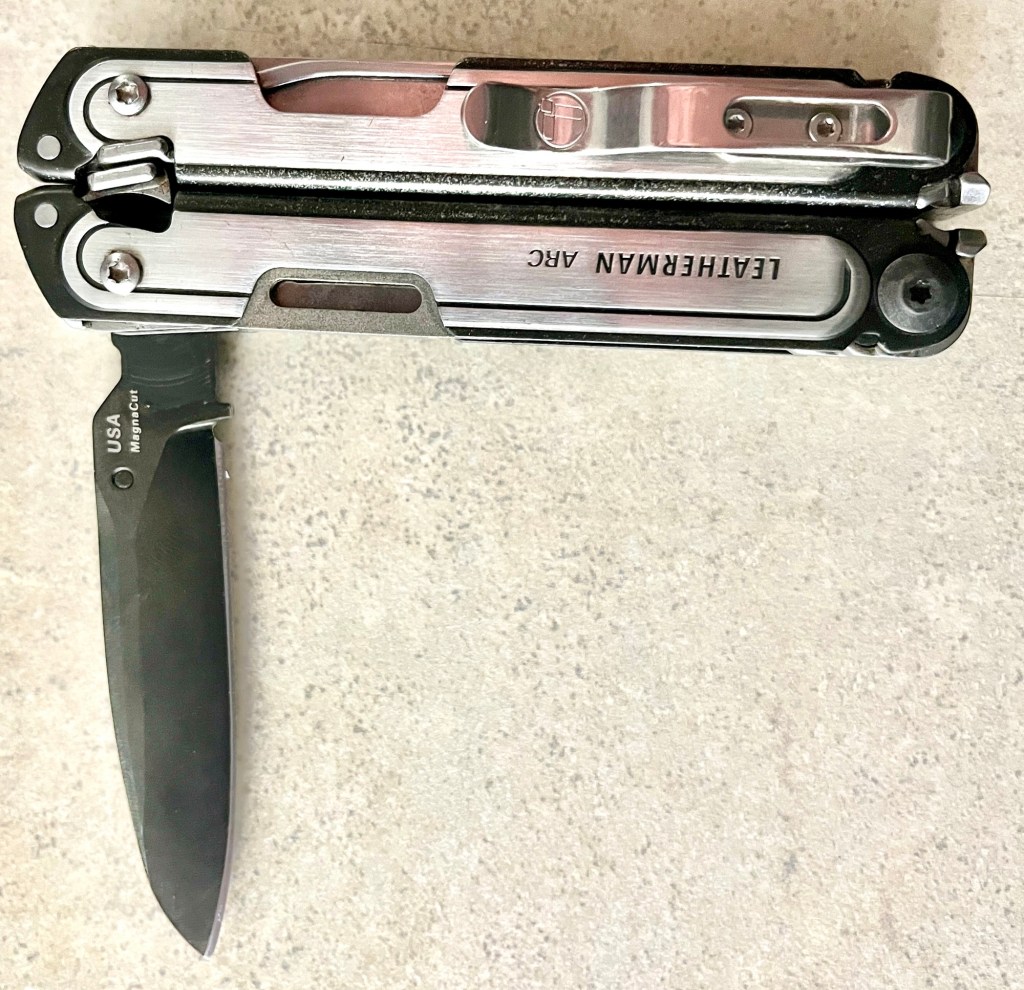
Obviously the blade is pretty important, and on the ARC this might be the most interesting. The addition of MagnaCut blade steel to this tool was bold move by Leatherman due to additional cost, but it was a serious draw for me. This steel is superb. With a little bit of care and a quick touch up on a diamond and ceramic pocket stone here and there I have kept this edge shaving sharp even though I abuse the heck out of it. Cardboard is infamously tough on knife edges, but the wear I’ve seen on the MagnaCut is minimal. In the 10 months I have carried the Arc, I have spent probably less than ten minutes total with the blade on a stone. Relatively frequent strokes across the diamond followed by a few light honing strokes on the ceramic and I can pop hairs off my wrist. Seriously, it’s maybe a total of ten strokes every week or two and I am good to go. I have pocket and fixed blade knives with all kinds of exotic blade steels, I love my various CPM blade steels in my Spydercos, but they dont compare to MagnaCut.
The Other Tools:
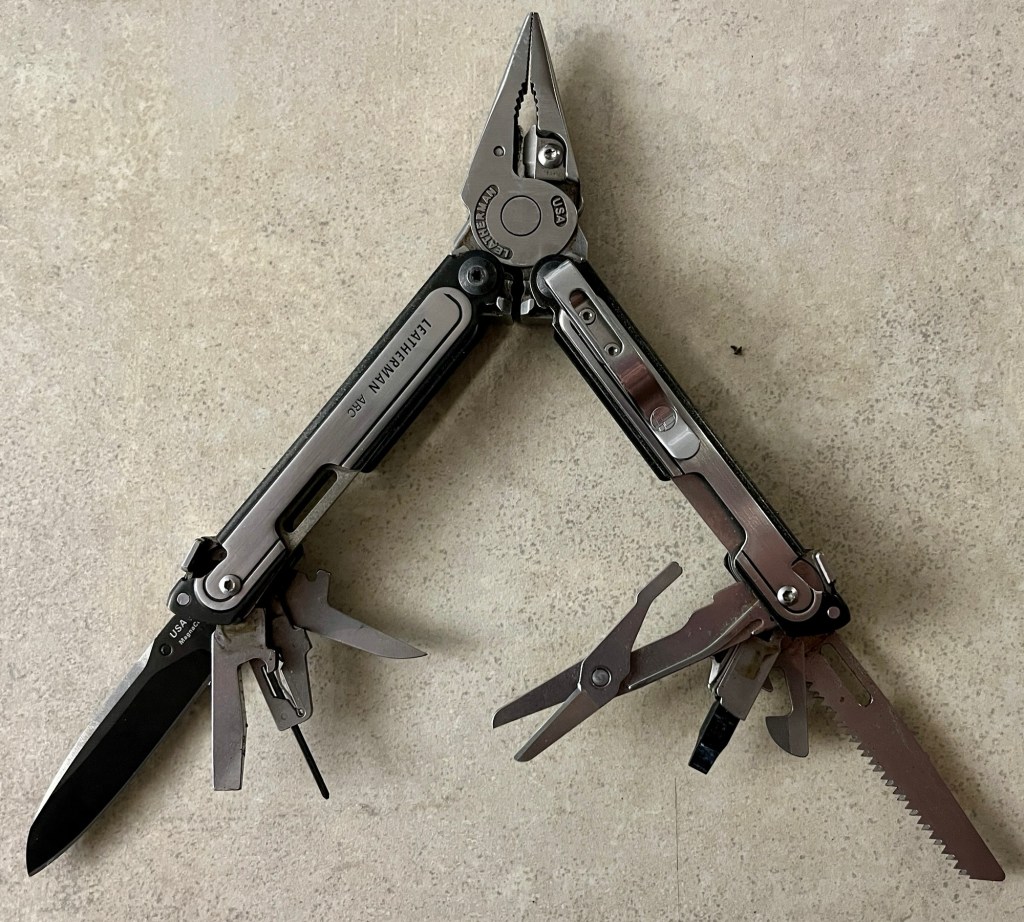
The rest of the tools all add up to a package that is very handy. Aside from the saw, I still fail to recognize why multi tool manufacturers continue to push saws on us. I am no stranger to being in the woods and nature, but if I am planning on being out there, Ill have a saw or mini-ax that will cover 1000x more usefulness than that little saw. And if I find myself in the woods and didn’t get to plan accordingly, I’ll be focusing on getting out, still not needing a tiny saw. That tool slot for my purposes would be much better filled by a small precision blade, scraping tool, scalpel blade holder, or full edge serrated 420C steel blade. The rest of the tools have their use and work well for what they are. Adding in the ratcheting driver extension for the flat bit driver is a nice upgrade, I have one, it stays in my EDC bag and I grab it semi-frequently when I find myself working in a panel in an impromptu setting.
Form Factor and Function:
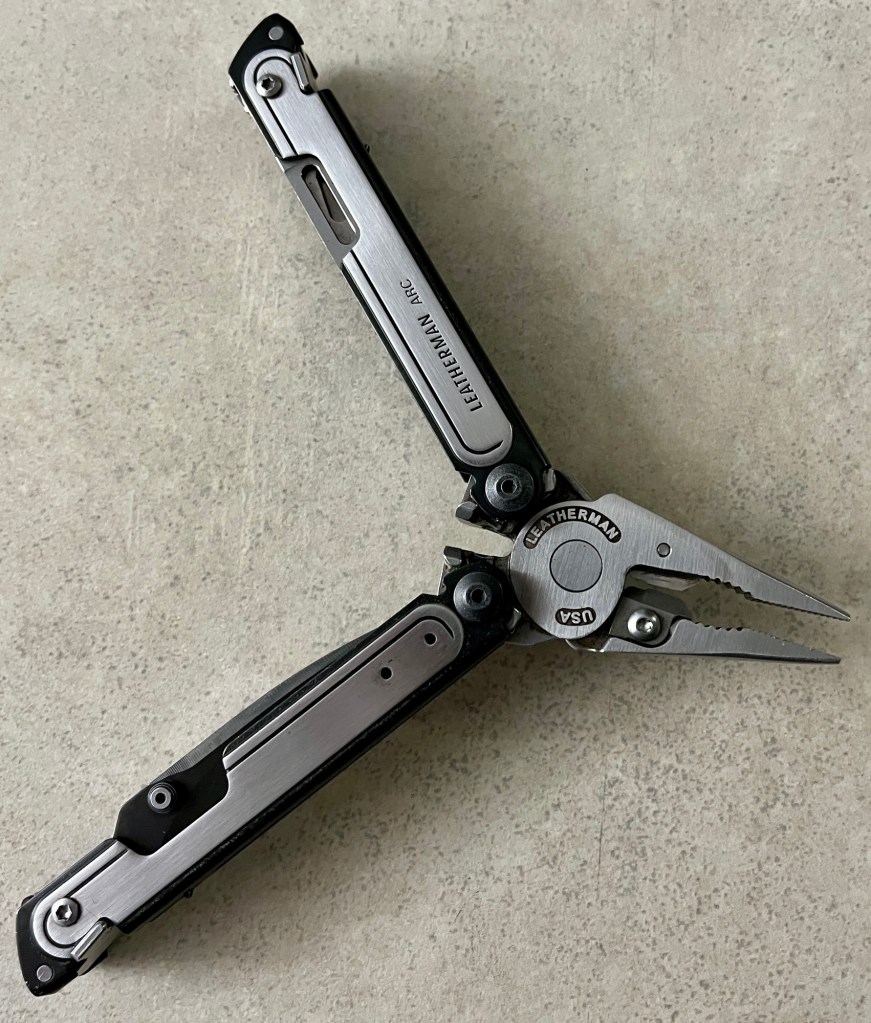
The magnet tech brought over from the Free series is fantastic. Being a lefty I appreciate the ambidextrous tool releases and belt clip being able to be swapped. The ease with which the tool open is a bit of a double edged sword for me, its easy one handed operation is great when you need it, but it also becomes a fidget toy for me real fast. It can be swung open and closed a la butterfly knife, which I do. A lot. To the detriment of my coworkers sanity it seems some days. Functionally, though, this is still a win for Leatherman, I would hope they will continue this technology into the rest of their lineup.
My EDC Use Case:
This tool fits into my life well. Due to the industrial nature of my career choice I routinely find myself needing to open an electrical or electronics panel to troubleshoot or make small adjustments etc. If I’m not gutting and re-wiring, I’ll usually just grab the Arc out of my pocket and do what needs to be done. With a little bit of a learning curve it’s not too hard to figure out using the bottom section of the cutters to strip wire, or the underside of the hinge to crimp a barrel connector. Obviously the screwdrivers turn screws. Pinching off hoses, holding nuts in place to thread bolts into, strip insulation, cut zip ties, open packaging, bore or enlarge holes, pry, all things this tool does at least acceptably at. Make no mistake, every dedicated tool that is emulated on a Leatherman is a compromise for portability. The old adage is true “Jack of All Trades, Master of None”
- The Hierarchy of Learning 1.0
My everyday job has various tasks, projects, and requirements; they all revolve around personnel development and growth however. I am responsible for the development and continued growth of a varied group of individuals, ranging widely in demographics. With differing levels of experience, skills and knowledge, not to mention generational, social, and cultural differences, standardizing a learning management system can be challenging.
While I can easily work at an individual level with any of these guys to address any gaps in skills or knowledge with hands on training, it’s not very efficient. Especially when these 100+ individuals are geographically spread out all over creation, not to mention constantly moving. I have to find a way to cast a wide net to catch these individuals simultaneously. This is where a distributed learning management system comes in.
I got my feet wet with eLearning modules to send out through our existing system that is severely lacking, but in place nonetheless. Soon after I followed up the eLearning modules with skills training videos demonstrating specific tasks, repairs and maintenance procedures. Now it’s time to get into the more esoteric learning: theory, principles and fundamentals. High level concepts that apply widely to most if not all aspects of Marine Engineering.
This brings me to where I stand today, developing engaging training over less than engaging topics. The basics of troubleshooting, various mechanical concepts, the simple machines, learning how to learn, soft skills such as business writing and interpersonal relationship building. Stuff that if you’re not already drawn to by natural curiosity can be mundane and tedious. But I have to start somewhere, these things are important, and more than some of the people I am beholden to are working with a high school or lower level education. I love our guys, they’re the main reason I have lasted over a decade in this industry, but some of them ended up in the roles they hold today because they didn’t fit the mold of traditional education and societal norms. Due to the nature of the positions they hold, we are better for it, them having these personal characteristics. It’s just another of the unique challenges I face, and adds some spice to the palate of my role.
The Hierarchy of Learning
Before I can make a lasting impact and enact real change I have to understand, at least at a basic level, how individuals like this learn and grow in the context of a professional setting pertaining to the requirements of their roles. I have been tossing this idea around in my head for a while, this idea of a hierarchy of learning. A fundamental truth, cast wide enough to encompass all the differences visible in our personnel files, but able to be presented in a concise, easy to digest manner that will lay foundational stones for the future. Think something that rings true, but can be taught with a simple infographic.
To me it starts with two questions. “Do you know what to do?” “Do you know how to do it?” There is a third part of this “Do you do it” but that does not apply to a learning system. The “it” in these questions is actually a multi-faceted concept, and relates to the expectations of the role. Further breaking this down, getting to the meat of the subject is a flow path of ascension to greatness. Ok, cheesy lines aside, breaking down the questions at hand and understanding how on-the-job training goes in this industry leaves me with a useful flow path to work with: Placement -> Exposure -> Experience -> Knowledge.
This is where I am as of today. I am still kicking around what all this means for my system and how I will proceed. More to come as I work through this demon of mine.
• • •
 DW Industries